Beyond the one-horned rhinoceros and swaying elephant grass of Kaziranga National Park lies a tapestry of human heritage as ancient and precious as the wildlife itself. Here, where the mighty Brahmaputra curves through Assam's heartland, indigenous communities have woven their stories into the very fabric of the landscape for millennia.
This is not merely tourism. This is cultural pilgrimage.
The villages surrounding Kaziranga pulse with the rhythm of 67 distinct ethnic groups, each carrying forward traditions that predate written history. Step into these settlements, and you witness not preserved artifacts but living culture - breathing, evolving, yet rooted in ancestral wisdom.
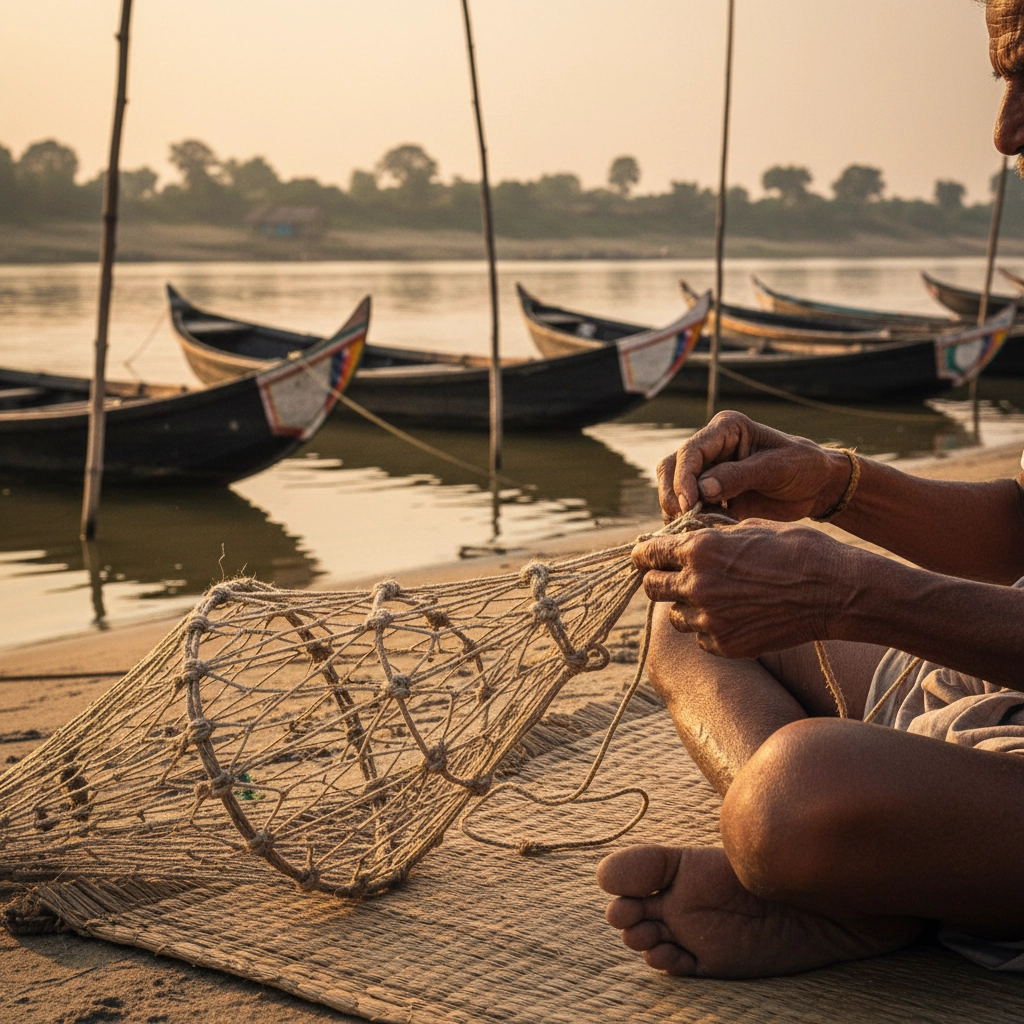
The Mishing people of nearby Majuli island embody this continuity most profoundly. Their connection to the Brahmaputra runs deeper than the river itself - flowing through their fishing nets, their boat-building techniques, their medicinal knowledge drawn from forest pockets. Watch a Mishing elder craft a traditional dhow by the riverbank, and you observe ten centuries of maritime wisdom passed down through calloused hands.
Their Buddhist and Vaishnav practices merge seamlessly with daily life. Prayer wheels spin beside spinning wheels. Temple bells harmonize with loom rhythms. This is faith as lived experience, not performance.
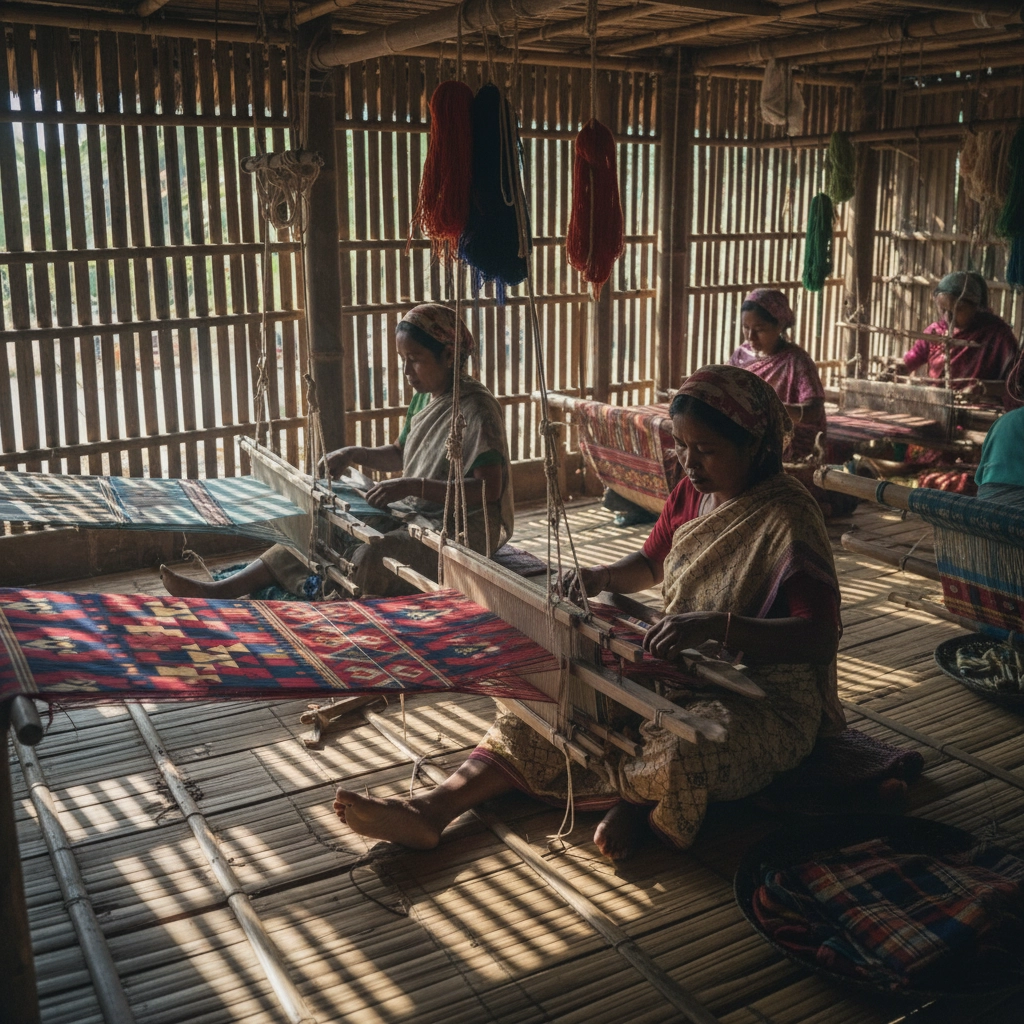
Enter any Bodo village near Kaziranga, and you encounter architecture as philosophy. Their traditional stilt houses rise like prayers above the floodplains - practical wisdom encoded in bamboo and thatch. But it is in their weaving that the Bodo people reveal their deepest artistry.
These are not mere fabrics. These are visual vocabularies - patterns that speak of monsoon cycles, river migrations, forest spirits. Each thread carries meaning. Each color tells stories of harvest seasons and celestial movements.
The women who work these looms are not craftspeople but cultural librarians, preserving knowledge through silk and cotton. Their fingers remember what books forget.
Journey deeper into Tai Phake and Singpho villages, and modernity seems to pause respectfully at the threshold. Here, life moves by older clocks - sunrise for fishing, seasonal rains for planting, harvest moons for celebration.
These communities practice what urban planners now call "sustainable living" but what they simply call life. Their livestock graze on community lands. Their fishing follows river rhythms. Their handicrafts emerge from materials the forest provides freely.
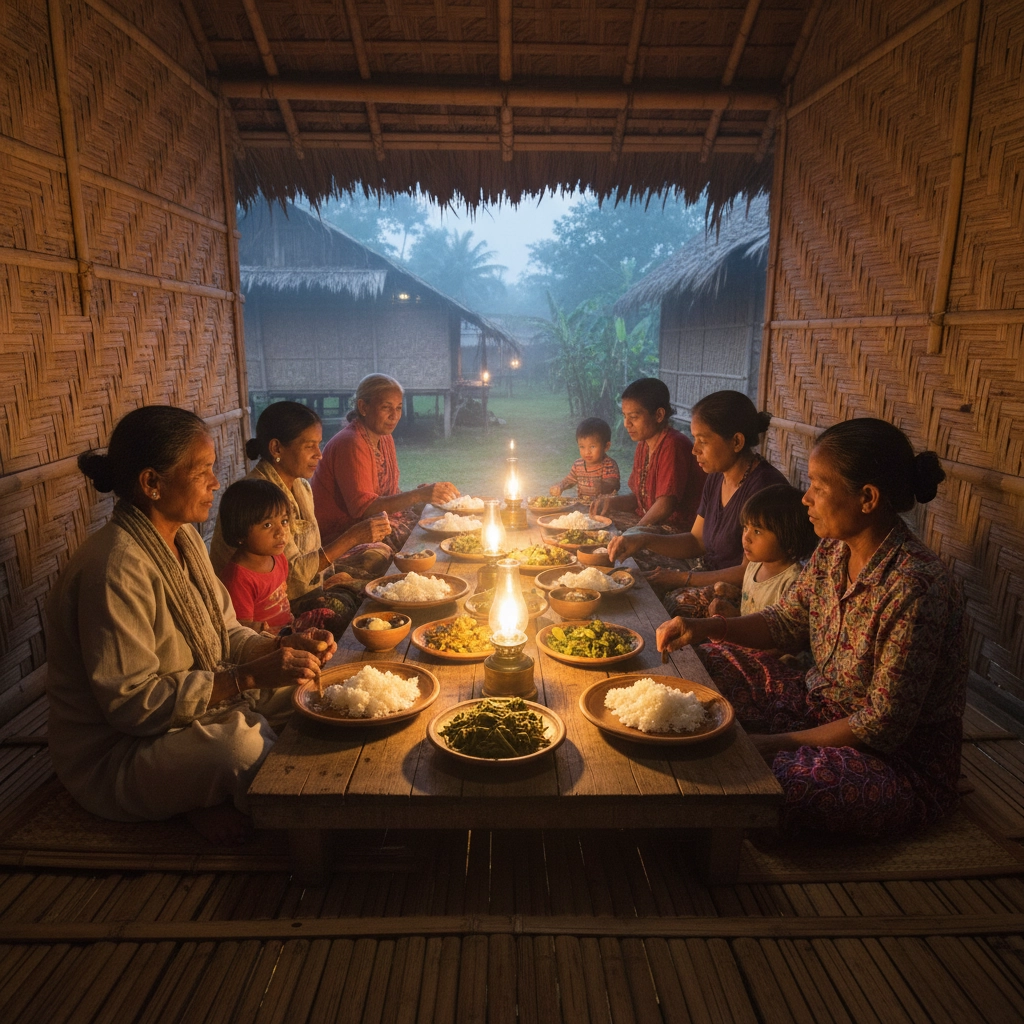
Stay overnight in a Tai Phake homestay, and you taste rice grown in their fields, vegetables from their gardens, fish caught from their waters. This is not farm-to-table dining - this is table-from-farm living, where the boundary between sustenance and culture dissolves entirely.
Though the living root bridges belong primarily to Meghalaya's Khasi people, their engineering philosophy echoes throughout Northeast India's tribal consciousness. These are not bridges built across nature but bridges grown from nature - patience made manifest in living wood.
This same wisdom manifests differently among Kaziranga's surrounding communities. Sacred groves protected by ancient taboos. Forest patches preserved for ritual use. Rivers regarded as divine entities deserving respect, not exploitation.
These are conservation practices that predate environmental science by millennia, yet remain more effective than many modern interventions.
Walk through any village sacred grove with tribal elders, and you enter outdoor cathedrals where every tree has genealogy, every stream carries stories. The Singpho people maintain such groves not as museum pieces but as living temples - spaces where the sacred and ecological intersect.
Here, tree-felling is forbidden not by law but by reverence. Hunting is restricted not by regulation but by spiritual covenant. These communities understand what modern environmentalism struggles to articulate: the sacred and sustainable are inseparable.

The Bihu celebrations of Assam reveal tribal heritage at its most joyous. But venture beyond the widely known Bihu to witness the Mishing people's seasonal festivals, and you discover rhythm as cultural DNA.
These are not performances for outsiders but conversations with the cosmos. Dance steps that mirror bird migrations. Songs that echo river currents. Instruments crafted from bamboo that grows in their own forests.
When communities gather for these celebrations, they enact stories older than empires - creation myths, harvest gratitudes, ancestral honors. Each festival is both celebration and curriculum, teaching younger generations their place in the larger choreography of existence.
The Orchid and Biodiversity Park at Kaziranga houses more than plant specimens - it preserves the artistic expressions of Assam's tribal heritage. But the real cultural exchanges happen in village markets, where Bodo textiles meet Mishing pottery, where Tai Phake bamboo crafts converse with Singpho metalwork.
These markets operate by different economics - not merely profit and loss but relationship and reciprocity. Trade becomes cultural exchange. Commerce becomes community building.
The British-era tea plantations surrounding Kaziranga tell complex stories of cultural collision and adaptation. Tribal communities who once lived solely from forest and river learned to navigate colonial labor systems while maintaining their cultural integrity.
Today's tea estate experiences reveal this layered heritage - indigenous knowledge of local botanicals meets colonial cultivation techniques meets contemporary organic practices. The tea pluckers who guide visitors through their daily routines carry forward traditions that bridge three centuries of change.
To experience this tribal heritage authentically requires cultural humility and genuine curiosity. This is not about collecting experiences but about receiving teachings. Not about taking photographs but about taking time.
Stay longer. Listen deeper. Participate rather than observe. Let Mishing fishermen teach you their nets' geometry. Learn from Bodo weavers how patterns carry meaning. Sit with Tai Phake elders as they share stories their grandparents told them.
The Brahmaputra River serves as more than geography - it is the thread that weaves together Tibetan Buddhism from the north, Assamese Hinduism from the heartland, Bengali Islam from the delta. In its flow, three civilizations meet and mingle, creating cultural currents as complex as its waters.
This river has carried monks and merchants, warriors and wanderers, traditions and transformations. To understand Northeast India's tribal heritage, one must first understand this river's role as cultural highway - connecting isolated communities to larger stories while allowing them to maintain their distinctive voices.
The communities around Kaziranga are not isolated remnants of the past but vibrant participants in ongoing cultural conversations - keeping what serves life, adapting what serves survival, sharing what serves the common good.
This is their gift to thoughtful travelers: the wisdom to see heritage not as museum display but as living practice, culture not as performance but as breath, tradition not as burden but as blessing passed forward.
Here, beside Kaziranga's ancient grasslands, human heritage and natural heritage dance together in eternal partnership - each preserving the other, each enriching the other, each pointing toward ways of being that honor both roots and wings.

.jpeg)


